Vulnerability Findings Cron
Retrieves vulnerability data and associated metadata for assets from Crowdstrike Falcon Spotlight, including details like CVE identifiers, CVSS scores, descriptions, solution information, and affected systems.
Sync Type: Full Synchronization
Requirements
- Before you connect Monad to CrowdStrike, you need a Client ID and Client Secret. Log in to your CrowdStrike portal, and under Support & Resources, click on 'API Client and Keys' to create your credentials.
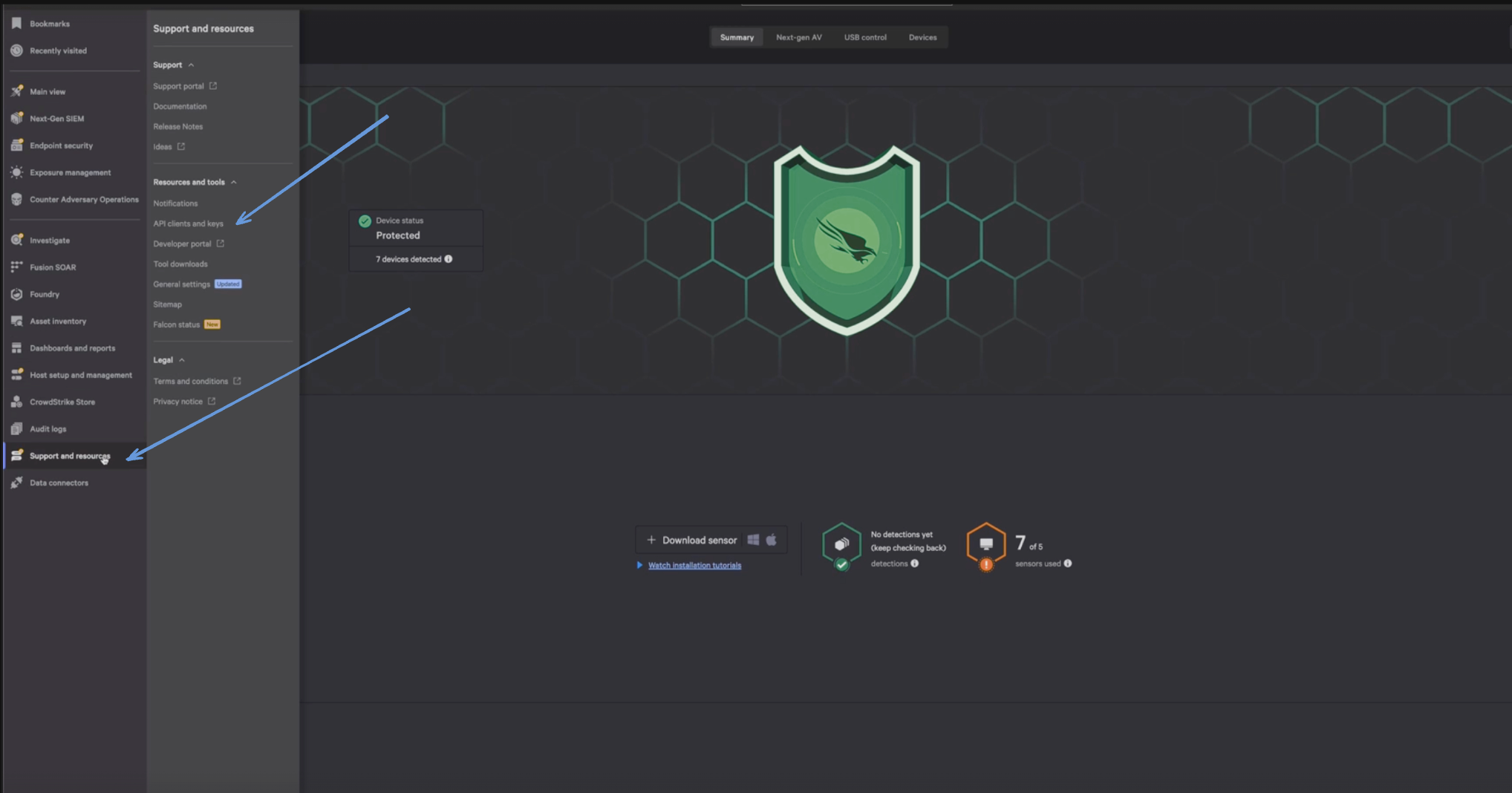
- Enter a Client Name, Description and API Scopes to define the API client. Ensure read roles for User Management are enabled.
- Click Done.
- Copy the ClientID and ClientSecret key. You'll need them when you set up the Monad connector.
Details
The same vulnerabilities from crowdstrike-vulnerabilities are returned but a full sync is performed based on a set cron schedule.
Configuration
The following configuration defines the input parameters. Each field's specifications, such as type, requirements, and descriptions, are detailed below.
Settings
| Setting | Type | Required | Description |
|---|---|---|---|
| Cron | string | Yes | Cron string for scheduling tasks. Ex: '0 0 * * *' for daily execution at midnight. |
| Cloud Type | string | No | Your cloud type for CrowdStrike. Ex: 'autodiscover', 'us-1', 'us-2', 'eu-1', 'us-gov-1'. |
Secrets
| Secret | Type | Required | Description |
|---|---|---|---|
| Client ID | string | Yes | Client ID for the CrowdStrike API. This is required to authenticate requests. |
| Client Secret | string | Yes | Client Secret for the CrowdStrike API. This is required to authenticate requests. |
OCSF Conversion
The following JQ transformation converts Crowdstrike Vulnerability data to OCSF Version 1.1 compliant format.
JQ Transformation
# Helper function to safely convert timestamp
def safe_timestamp:
  if . and (. | type) == "string" then (. | fromdateiso8601) else null end;

# Helper function to convert Crowdstrike severity to OCSF severity_id
def severity_to_id:
  if . == "CRITICAL" then 5
  elif . == "HIGH" then 4
  elif . == "MEDIUM" then 3
  elif . == "LOW" then 2
  else 99  # Unknown
  end;

# Helper function to convert status to OCSF status_id
def status_to_id:
  if . == "open" then 1
  elif . == "closed" then 2
  elif . == "in_progress" then 3
  else 99  # Unknown
  end;

# Main transformation
{
  # Required OCSF Fields
  "activity_id": 1,  # Detection
  "category_uid": 2, # Findings
  "class_uid": 2002, # Vulnerability Finding class
  "type_uid": 200201, # Vulnerability Finding type

  # Timestamps
  "time": (.created_timestamp | safe_timestamp),

  # Severity mapping
  "severity_id": ((.cve.severity // "UNKNOWN") | severity_to_id),
  "severity": (.cve.severity // "UNKNOWN"),

  # Finding Info
  "finding_info": {
    "title": (.vulnerability_id // "UNKNOWN"),
    "uid": (.id // "UNKNOWN"),
    "desc": (.cve.description // "No description available"),
    "created_time": (.created_timestamp | safe_timestamp),
    "modified_time": (.updated_timestamp | safe_timestamp)
  },

  # Vulnerabilities array
  "vulnerabilities": [
    {
      "title": (.vulnerability_id // "UNKNOWN"),
      "desc": (.cve.description // "No description available"),
      "severity": (.cve.severity // "UNKNOWN"),
      "cve": {
        "uid": (.vulnerability_id // "UNKNOWN"),
        "desc": (.cve.description // "No description available"),
        "cvss": [
          {
            "version": "3.1",
            "base_score": (.cve.base_score // 0),
            "vector_string": (.cve.vector // "UNKNOWN")
          }
        ],
        "references": (.cve.references // []),
        "modified_time": (.updated_timestamp | safe_timestamp)
      },
      "remediation": {
        "desc": (
          if .remediation and .remediation.entities then
            (.remediation.entities | map(.action) | join("; "))
          else
            ""
          end
        ),
        "references": (
          if .remediation and .remediation.entities then
            (.remediation.entities | map(.link) | map(select(length > 0)))
          else
            []
          end
        ),
        "kb_articles": (
          if .remediation and .remediation.entities then
            (.remediation.entities | map(.reference) | map(select(length > 0)))
          else
            []
          end
        )
      },
      "first_seen_time": (.created_timestamp | safe_timestamp),
      "last_seen_time": (.updated_timestamp | safe_timestamp),
      "is_exploit_available": false
    }
  ],

  # Instead of using tostring, lets include a simplified version of raw data
  "raw_data": {
    "id": .id,
    "vulnerability_id": .vulnerability_id,
    "status": .status,
    "timestamp": .created_timestamp
  },

  # Metadata
  "metadata": {
    "version": "1.1.0",
    "product": {
      "name": "Crowdstrike Spotlight",
      "vendor_name": "Crowdstrike",
      "version": "1.0"
    },
    "profiles": ["vulnerability"],
    "uid": (.id // "UNKNOWN")
  },

  # Optional Fields
  "confidence": (.confidence // "UNKNOWN"),
  "confidence_id": (
    if .confidence == "confirmed" then 2
    elif .confidence == "high" then 2
    elif .confidence == "medium" then 1
    elif .confidence == "low" then 0
    else 99  # Unknown
    end
  ),

  "status": (.status // "unknown"),
  "status_id": ((.status // "unknown") | status_to_id),

  # Resource Details
  "resource": {
    "type": "host",
    "name": (.host_info.hostname // "unknown"),
    "uid": (.aid // "unknown"),
    "criticality": (.host_info.asset_criticality // "Unassigned"),
    "group": {
      "name": (
        if .host_info.groups and (.host_info.groups | type) == "array" then
          (.host_info.groups | join(", "))
        else
          ""
        end
      )
    },
    "labels": [
      (.host_info.os_version // "unknown"),
      (.host_info.platform // "unknown"),
      (.host_info.product_type_desc // "unknown")
    ]
  },

  # Cloud context if available
  "cloud": (
    if .host_info and .host_info.service_provider then {
      "provider": (.host_info.service_provider // "unknown"),
      "account_uid": (.host_info.service_provider_account_id // "unknown"),
      "instance_uid": (.host_info.instance_id // "unknown")
    } else null
    end
  )
}
OCSF Mapping Details
Helper Functions
-
safe_timestamp
- Safely converts ISO8601 timestamps to Unix epoch
- Returns null for any invalid or missing timestamps
- Used consistently across all timestamp fields
-
severity_to_id
- Maps Crowdstrike severity levels to OCSF enumerated values:
- CRITICAL → 5
- HIGH → 4
- MEDIUM → 3
- LOW → 2
- Others → 99 (Unknown)
- Maps Crowdstrike severity levels to OCSF enumerated values:
-
status_to_id
- Maps vulnerability status to OCSF enumerated values:
- open → 1
- closed → 2
- in_progress → 3
- Others → 99 (Unknown)
- Maps vulnerability status to OCSF enumerated values:
Core Fields
- Category UID: 2 (Findings)
- Class UID: 2002 (Vulnerability Finding)
- Activity ID: 1 (Detection)
- Type UID: 200201 (Vulnerability Finding type)
- Time: Maps from created_timestamp using safe_timestamp function
- Severity: Maps from cve.severity with "UNKNOWN" fallback
- Severity_id: Maps from cve.severity using severity_to_id function
Finding Information
- Title: Maps from vulnerability_id with "UNKNOWN" fallback
- UID: Maps from record id with "UNKNOWN" fallback
- Description: Maps from cve.description with "No description available" fallback
- Timestamps:
- created_time: Maps from created_timestamp using safe_timestamp
- modified_time: Maps from updated_timestamp using safe_timestamp
Vulnerabilities Array
Each vulnerability entry contains:
- Title and description from CVE data
- Severity information with fallbacks
- CVE details including:
- UID: Maps from vulnerability_id with "UNKNOWN" fallback
- Description: Maps from cve.description with "No description available" fallback
- Base score from cve.base_score (defaults to 0)
- Vector string from cve.vector with "UNKNOWN" fallback
- References from cve.references (defaults to empty array)
- Modified time from updated_timestamp
- Remediation information:
- Description: Combines actions from remediation.entities
- References: Maps from links in remediation.entities
- KB articles: Maps from reference field in remediation.entities
- Each with empty string/array fallbacks if data is missing
- Timestamp fields using safe conversion
Raw Data
Simplified version of raw data containing:
- id
- vulnerability_id
- status
- timestamp from created_timestamp
Status and Confidence
- Status: Maps from status field with "unknown" fallback
- Confidence: Maps from confidence field with "UNKNOWN" fallback
- Both use enumerated ID mappings with unknown (99) fallback
Resource Details
- Type: Fixed as "host"
- Name: Maps from hostname with "unknown" fallback
- UID: Maps from aid with "unknown" fallback
- Criticality: Maps from asset_criticality with "Unassigned" fallback
- Groups: Combines all group names, filtering empty values
- Labels: Array including:
- OS version
- Platform
- Product type All with "unknown" fallbacks
Cloud Context
Only included when service_provider exists, containing: All fields have "unknown" fallbacks
- Provider: Maps from host_info.service_provider with "unknown" fallback
- Account_uid: Maps from host_info.service_provider_account_id with "unknown" fallback
- Instance_uid: Maps from host_info.instance_id with "unknown" fallback
Metadata
- Version: Fixed at "1.1.0"
- Product Information:
- Name: "Crowdstrike Spotlight"
- Vendor: "Crowdstrike"
- Version: "1.0"
- UID: Maps from id with "UNKNOWN" fallback
Error Handling
The transformation implements comprehensive error handling:
-
Timestamp Handling
- No artificial timestamps created
- Explicit null for invalid/missing dates
- Consistent handling across all date fields
-
Missing Data
- String fields: "UNKNOWN" or "unknown" fallbacks
- Numeric fields: 0 fallback
- Arrays: Empty array fallback
- Objects: Null fallback with conditional inclusion
-
Array Processing
- Safe mapping with null element handling
- Filtering of empty/null values
- Join operations with empty string fallbacks
-
Object Safety
- Null checks before accessing nested fields
- Default values for all required fields
- Conditional object inclusion