Fetches actor intelligence data to enhance threat correlation and investigation workflows.
Sync Type: Full Synchronisation
Requirements
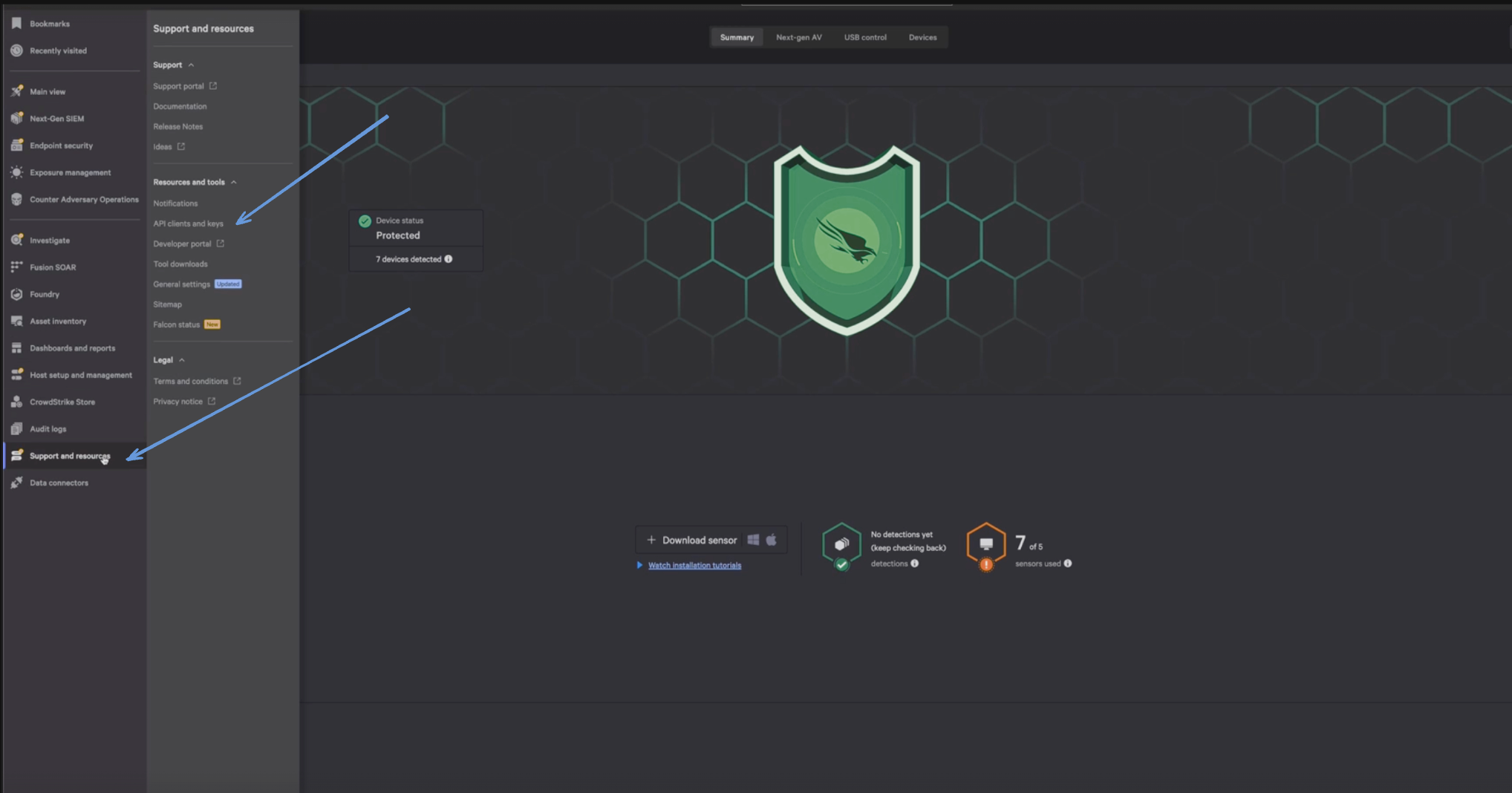
Before you connect Monad to CrowdStrike, you need a Client ID and Client Secret. Log in to your CrowdStrike portal, and under Support & Resources, click on 'API Client and Keys' to create your credentials.
Enter a Client Name, Description and API Scopes to define the API client. Ensure read roles for Actors (Falcon Intelligence) are enabled.
Click Done.
Copy the ClientID and ClientSecret key. You'll need them when you set up the Monad connector.
Details
Monad uses the cron field to run this input on specific intervals and returns all actors' details, performing a full sync of data each time.
Configuration
The following configuration defines the input parameters. Each field's specifications, such as type, requirements, and descriptions, are detailed below.
Settings
Setting
Type
Required
Description
Cron
string
Yes
Cron string for scheduling tasks. Ex: '0 0 * * *' for daily execution at midnight.
Sort
string
No
Order fields in ascending or descending order. Ex: 'created_date
Cloud Type
string
No
Your cloud type for CrowdStrike. Ex: 'autodiscover', 'us-1', 'us-2', 'eu-1', 'us-gov-1'.
Actor Type
string
No
Type of actor. Ex: 'APT', 'eCrime', 'Hacktivist', 'Insider Threat', 'Nation-State', 'Unknown', 'Other', etc.
Target Industries
string
No
Industries targeted by the actor. Ex: 'Financial', 'Healthcare', 'Energy', 'Government', 'Manufacturing', 'Technology', etc.
Secrets
Secret
Type
Required
Description
Client ID
string
Yes
Client ID for the CrowdStrike API. This is required to authenticate requests.
Client Secret
string
Yes
Client Secret for the CrowdStrike API. This is required to authenticate requests.